A decade ago, buying a wedding dress without trying it on would have sounded reckless. Today a substantial share of brides do exactly that, and many of them order made to measure from a designer in another country. Buying made to measure online means a designer cuts a dress to measurements you send, with no in-person fitting, and ships it to you. It works far more often than the horror stories suggest, and it goes wrong in predictable ways that can be spotted in advance. This guide explains how a good process works, where the risks are, and the questions that separate a designer from a listing.
Why do brides order wedding dresses online?
Three reasons come up again and again. The style they want is not available locally, or only in one salon at a price they cannot justify. They dislike the salon experience: the appointment, the audience, the pressure. Or they have a body that standard sizes do not fit, and a made-to-measure dress from a small designer is the first thing that has ever fitted properly.
What 156 brides said afterwards. We read every verified review left for the studio that publishes this journal, 156 of them, all from brides who ordered made to measure without a single in-person fitting. Nearly one in five (19%) opened by saying she had been nervous or hesitant about buying a wedding dress online. Almost half (48%) wrote about the fit, and 12% mentioned having alterations done locally, which is roughly the share we would expect for a dress made from self-taken measurements. More than a quarter (28%) singled out communication with the designer during the making. The average rating was 4.99 out of 5. The nerves, in other words, are normal, and the process is what settles them.
None of these is a bad reason. The question is whether the process on the other end is sound.
What does a good online made-to-measure process look like?
A sound process has a named designer, a measurement guide you can follow, a conversation before the order, a written policy on fit, progress photographs and a realistic timeline.
A named designer and a real studio. You should be able to see who makes the dress, where, and what else they have made. Photographs of the same dress on different real customers, not only on one model, are the single most reassuring thing a site can show.
A measurement guide you can follow. Usually a video and a diagram, covering bust, underbust, waist, hips, hollow-to-hem, shoulder width, arm length and several more. A good designer asks you to measure twice, asks for photographs in fitted clothing, and queries anything that does not add up. For a sense of what a complete guide looks like, the studio that publishes this journal has its measurement guide and a page on how made to measure works remotely open to anyone; other good studios publish something similar.
A conversation before the order. Made to measure is not a shopping cart. Expect questions about the venue, the season, the shoes, the underwear you plan to wear, and whether you intend to change size. If nobody asks, nobody is thinking about fit.
A written policy on what happens if it does not fit. Adjustments, remakes, contribution toward local alterations. Read it before you pay. A designer who has thought about this will say so plainly.
Progress photographs. Many designers send photographs at the toile stage and again before shipping. It is your only fitting, so ask for it.
Realistic timelines. Three to five months is normal. A promise of two weeks for a made-to-measure lace dress is either a stock dress being relabelled or a warning sign.
How do you measure yourself for a dress made remotely?
This is where online orders succeed or fail. The designer is working from numbers you supply, and a two-centimetre error in the underbust measurement is the difference between a bodice that sits and one that gapes.
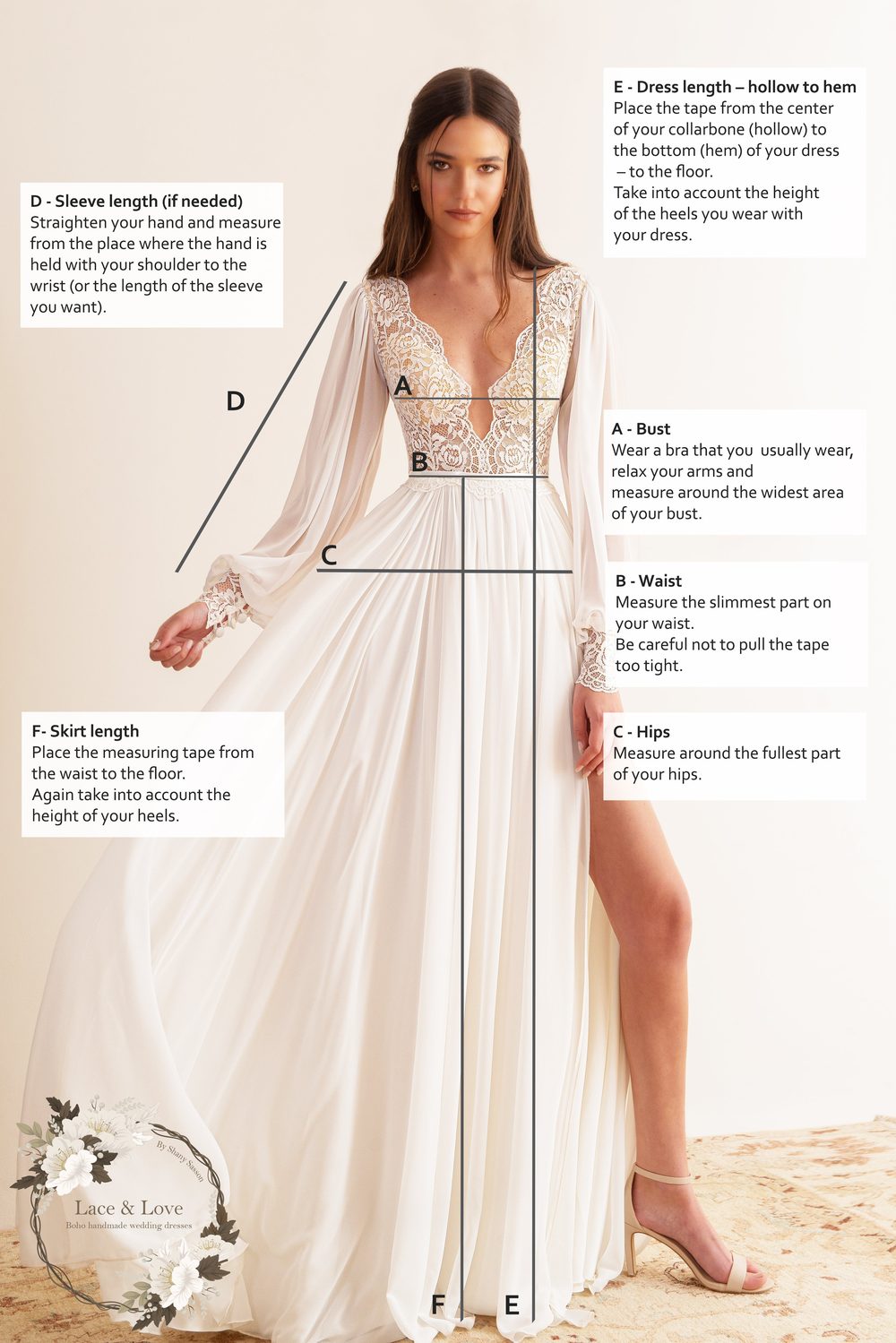
What helps:
- Have someone else measure you. Measuring your own back and shoulders is guesswork.
- Use a soft tape, snug but not tight, over the underwear you will actually wear.
- Measure twice on different days and send both sets if they differ.
- Send the photographs. A designer who sees the shape of your shoulders and the line of your back can catch a measurement that is clearly wrong.
- Ask how much ease is built in. Good designers leave a small seam allowance so a local seamstress can take in or let out. Ask where that allowance is.
And accept that a local seamstress will almost certainly be part of the plan. A dress made remotely from measurements and then hemmed and tweaked in person is a normal, successful outcome. A dress that arrives and is worn with no adjustment at all is the exception.
Red flags
- Photographs that appear on several unrelated sites, or on stock image searches.
- No named designer, no studio address, no way to speak to a person.
- A price that is a fraction of what the fabric alone would cost. Lace and silk have a floor.
- Reviews with no photographs, or photographs that are all professional.
- A returns policy that promises anything ("full refund if you are not delighted") without describing a process.
- Pressure: countdown timers, "only two left" on a made-to-measure item, discounts that expire at midnight.
- Refusal to send progress photographs.
Questions to ask before ordering
- Who makes the dress, and where?
- Can I see this exact design on three previous customers?
- What is your process if the dress arrives and does not fit?
- Is there an allowance for local alterations, and where?
- What is included: lining, cups, bustle, garment bag?
- What is the full timeline including shipping and customs?
- Can I see the fabric and lace swatches before you cut?
- Will you send photographs before shipping?
- What are the cancellation terms once fabric is cut?
- Who pays duties and taxes at my border?
The twelve questions for any dress purchase apply here too; the ones above are specific to distance.
The timeline, adjusted for distance
| Stage | When |
|---|---|
| Research and conversation with the designer | 7 to 9 months out |
| Measurements sent, order placed | 6 months out |
| Toile or progress photographs | 3 to 4 months out |
| Dress ships | 8 to 10 weeks out |
| Arrives, allowing for customs | 6 to 8 weeks out |
| Local seamstress, two fittings | 5 weeks to 1 week out |
Book the local seamstress before the dress arrives. Good ones are busy in wedding season, and a dress sitting in a box for three weeks while you find someone is the most common avoidable delay.
What should you do when the dress arrives?
Open it the day it comes. Try it on with the shoes and underwear you will wear. Check the bodice, the hem, the closure and the fabric against the swatch you kept. Photograph anything that concerns you and send it to the designer the same day, while the window for remote adjustment is open. Then take it to the seamstress.
The fittings guide explains what to test when you first try the dress on, and it applies just as much when the fitting is in your own bedroom. If you want to read verified reviews of a made-to-measure studio before ordering, a marketplace page is the most reliable place, because the platform checks that each reviewer bought the dress; the studio that publishes this journal keeps its reviews in its Etsy shop. For the lace and fabric questions worth asking before anything is cut, see the fabrics guide.