Fittings are where a dress becomes yours, and they are also where most of the avoidable problems begin. A fitting is an appointment where a seamstress adjusts the dress on your body, in the shoes and underwear you will wear on the day. A hem set to the wrong shoes, a strap adjusted before the bra was chosen, a bustle nobody learned to do. None of these are disasters, but each one is a small piece of the wedding you end up thinking about instead of enjoying.
Most dresses go through three or four fittings. The exact number depends on how the dress was bought, off the rack, ordered in a standard size or made to measure (the questions guide explains the difference), but the sequence is much the same. Here is what happens at each, what to bring, and what to check before you leave the room.
What should you bring to every fitting?
The shoes. From the second fitting onward, the exact shoes you will wear, not a similar pair. Hem length is set to the heel, and two centimetres of difference shows. If you plan to change into flats for dancing, bring both pairs and say so, because a hem set for heels will trail once you switch.
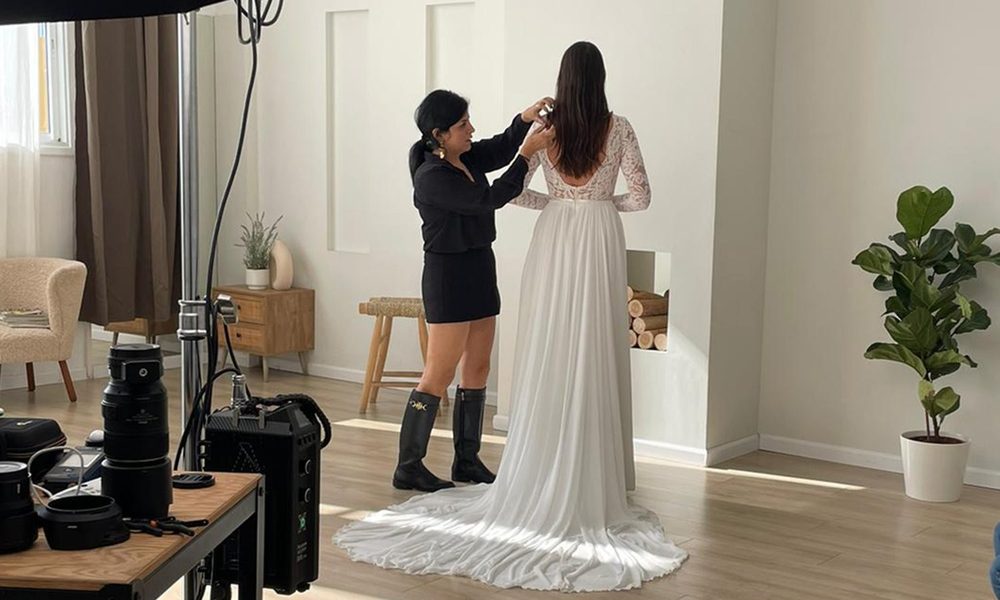
The underwear. The bra, cups, shapewear and knickers you will wear on the day. A dress fitted over a different bra fits a different body. Decide this before the second fitting, not after. Our guide to what goes under the dress covers the options.
Photographs of details. If you have asked for a change, bring a picture of what you mean. "A bit more open at the back" is a conversation; a photograph is an instruction.
One person. Not five. Bring the one person whose opinion you trust and who can be honest without being unkind. A crowd in a fitting room produces a chorus of opinions and a bride who cannot hear her own.
A notebook. Write down what was agreed and what will happen next, before you leave.
The first fitting
This happens when the dress arrives, or in made-to-measure work, before it is cut. The seamstress takes or confirms measurements, pins the obvious adjustments and confirms the design with you: neckline, sleeve, train length, closure.
What to check. That the dress in front of you is the dress you ordered. Fabric, colour, lace pattern, lining. Compare it to the sample if you can. Anything that differs is easier to raise now than at collection.
What to say. If you expect your body to change before the wedding, say so now. Planned weight loss, pregnancy, a new training programme, a medication change. A seamstress can plan for it, leave seam allowance in and delay the final fit. What she cannot do is guess.
What not to worry about. The dress will not fit. It is not supposed to yet. Excess fabric, a loose bodice and a long hem are normal at this stage.
What happens at the second fitting?
At the second fitting you test the fit in your wedding shoes and underwear, because after it the seamstress starts cutting fabric.
For made to measure, this is often the toile or muslin: a version of the dress in plain cotton that exists only to check fit and proportion. For an ordered dress, it is the real dress with the first round of alterations tacked in. Either way, this is the fitting where the shape is decided, and it is the last point at which big changes are straightforward.
Do the five tests, in the dress, with the shoes and underwear on.
| Test | What it tells you |
|---|---|
| Breathe deeply, three times | Whether the bodice is too tight through the ribs. You will breathe hard on the day. |
| Sit on a chair, then on a low sofa | Whether the bodice digs in at the waist or the skirt pulls. You will sit through a meal. |
| Raise both arms above your head | Whether sleeves, straps or a fitted bodice restrict you. Hugging people is part of the day. |
| Walk the length of the room and back, then turn | Whether the stride is comfortable and the skirt behaves. Try a small staircase if there is one. |
| Bend forward as if picking something up | Whether the neckline holds. Strapless and deep necklines fail this test most often. |
If anything fails, say so before the seamstress starts pinning. A bodice that feels tight at this stage will feel tighter after a meal and four hours of standing. A neckline that gapes when you bend forward will gape in every photograph taken from above.
Big changes. Lowering a back, moving straps, raising the flare of a fitted skirt, changing the sleeve: ask now. Some will be possible and some will not (the silhouettes guide explains which structural points are fixed), but after this fitting the seamstress begins cutting fabric, and the answer changes from "yes, at a cost" to "no".
The third fitting
The dress is close to finished and the work moves to the details.
Hem. With the shoes on, standing straight, then walking. The front hem should clear the floor by enough that you do not step on it, and the sides should not catch on the heel. Look at it in a full-length mirror from the side, not only from the front.
Straps and sleeves. Straps should stay put when you raise your arms and should not dig in when you lower them. Sleeves should let you bend your elbow fully.
Closure. Zip, buttons, hooks or lacing. Have it closed fully, then do the breathing and sitting tests again. A dress that closes on a held breath is a dress that will not close on the day.
Bustle. If the dress has a train, this is where the bustle is designed. Ask to see it up and down. Check that the bustled skirt clears the floor at the back and does not pull the waist seam. A French bustle sits under the skirt and looks cleaner; an over-bustle sits on top and is easier for a helper to find. Ask which you are getting.
What happens at the final fitting?
Everything should be finished. Try the dress on with every layer, do the five tests one last time, and then use this appointment for what it is really for: learning the dress.
Learn to close it. Have the seamstress show your helper how the closure works, then have your helper do it unassisted while the seamstress watches. Thirty covered buttons take longer than anyone expects, and a lace-up back has a right way and a wrong way.
Learn the bustle. Same process. Points, hooks, ribbons, loops: count them, and have your helper bustle the train alone. Then film the whole thing on a phone. On the day, in a hotel corridor, with a photographer waiting, the film will be worth more than the memory.
Check the bag. The dress should leave in a breathable garment bag, not plastic, with the veil and any belt or accessories packed with it or clearly separate. Ask how to hang it and how to steam it if it creases in transport.
What if something feels wrong?
Say it now, in the room, in plain words. Not "I think it might be fine", but "the bodice is tight here and I cannot breathe fully". Seamstresses are used to this. They would far rather hear it at the fitting than in an email the week before the wedding, when there is no time left to fix it.
Brides stay quiet for two reasons: they do not want to seem difficult, and they assume the professional knows better. On construction, the professional does know better. On how the dress feels from the inside, you are the only expert in the room. The fitting exists so you can say so.
Fittings go better when the underwear has been decided early. The guide to what to wear under the dress walks through cups, shapewear and petticoats by silhouette. And if you are still working out when each fitting should fall relative to the wedding, the timeline guide gives a schedule with buffer built in.