The dress gets the attention. What goes under it gets decided in a hurry, often the week before, and then the bodice sits differently because the bra is a different shape. Underwear is not a detail. It is part of the structure of the dress, and it changes the fit as surely as a seam does. What goes under a wedding dress is the support, shapewear and petticoat that give the bodice its shape and the skirt its volume.
This guide covers the options honestly, including the ones that do not work as well as their packaging says.
Why does underwear have to be decided before the second fitting?
A seamstress fits the dress to the body in front of her. If that body is wearing a padded bra at the second fitting and sewn-in cups at the wedding, the bodice will be too big at the bust and the neckline will sit differently. If shapewear appears for the first time on the day, the waist may be smaller than the one the dress was fitted to, and the bodice will ride up.
So the sequence is: decide the underwear, buy it, wear it to the second fitting and every fitting after, and change nothing. The fittings guide explains what else is locked in at that stage.
Do you need a bra under a wedding dress, or are cups enough?
There are three options, and the right one depends on the neckline, the fabric and your bust.
Sewn-in cups. Soft or moulded cups sewn into the lining of the bodice. They give shape and a little lift, they cannot be seen, and there are no straps to hide. Most made-to-measure dresses include them, and most ordered dresses can have them added at alterations. Their limit is support: cups hold a shape but do not hold weight.
A bra. A conventional, strapless or longline bra worn under the dress. Better support than cups alone, and the right choice for a fuller bust or a dress whose bodice is soft and unstructured. A bra needs a neckline high enough and a back closed enough to hide it, which rules out most strapless, backless and deep-V dresses.
No support. Possible in a dress with a fully boned and lined bodice that does the work itself, and for a smaller bust in a soft fabric where the natural line is the intention.
| Neckline | Usual solution |
|---|---|
| High neck, jewel, bateau | A bra with clear or low-set straps, or cups |
| V-neck or scoop, closed back | A plunge bra or cups |
| Strapless or sweetheart | Sewn-in cups plus a boned bodice; a longline strapless bra if the back allows |
| Halter or one shoulder | Cups, or a convertible bra with the strap rerouted |
| Open or low back | Cups sewn into a boned bodice; nothing else works reliably |
| Sheer or lace bodice | Cups in a lining matched to skin tone |
Fabric changes the answer. A stiff mikado or duchess satin bodice with boning can hold its shape with cups alone. A bias-cut silk, a soft crepe or a fine tulle shows every edge, so the answer is usually smooth cups sewn into a lining. Our fabrics guide explains which fabrics forgive and which do not.
What holds up a strapless or backless wedding dress?
This is where honesty matters, because the products sold for this problem promise more than they deliver.
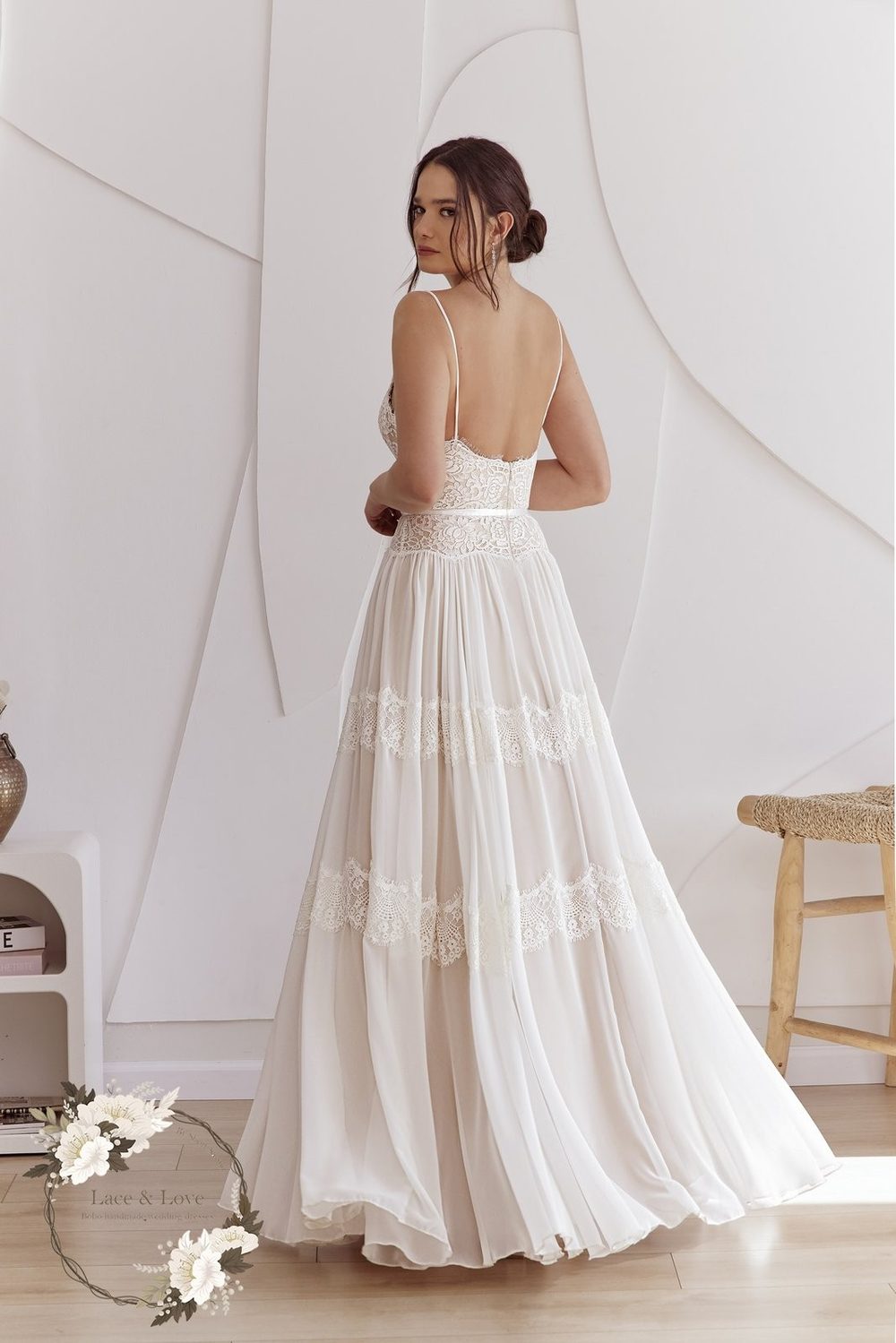
Adhesive bras. Silicone or fabric cups that stick to the skin. They give a little shape and no lift, they lose grip with heat and sweat (a summer wedding, a dance floor), and they can peel at the edge during a long day. They work for a small bust in a cool room for a few hours. For anything more, do not rely on them.
Corset-style boning. The best answer for strapless and backless dresses. A bodice with boning through the seams, a fitted waist stay and a firm lining holds itself up and holds you in. Ask at the first fitting whether the bodice is boned and how many bones it has. A strapless dress with two or three bones will slide; one with eight or ten will not. Combined with sewn-in cups, this is what actually holds up most strapless and backless dresses: the cups give the shape and the bodice does the lifting.
Tape. Fashion tape holds a neckline edge against skin and stops gaping. It is a finishing touch, not a support system.
Shapewear
Shapewear smooths. It does not reshape, and it does not replace a well-fitted dress.
When it helps. Under a slim, unlined fabric such as crepe or satin, a smoothing short or slip evens out lines from knickers and the transition at the hip.
When it shows. The edges of shapewear show as ridges under thin fabric, usually at the thigh and above the waist. Try the dress over the shapewear at a fitting under bright light and look from behind and from the side. A high-waisted short that ends above the waist seam is usually the safest.
The breathing trade-off. Firm shapewear compresses the ribs and stomach. That is what it is for, and it is also why brides feel faint during the ceremony and cannot eat at the meal. Choose the lightest control that gives the line you want, wear it for a full evening at home before the wedding, and be honest about whether you can live in it for ten hours.
Colour. Match shapewear to your skin, not to the dress. A white or ivory piece under an ivory dress shows as a brighter panel; a piece close to your skin tone disappears.
What goes under the skirt: petticoat, hoop or crinoline?
A sheath or empire dress needs nothing under the skirt, an A-line needs a light tulle petticoat, and a ball gown needs a multi-layer petticoat or a hoop. The volume under a skirt is a separate purchase, and it is usually not included (the questions guide has a list of what tends to be extra). What you need depends on the silhouette.
| Silhouette | Under the skirt |
|---|---|
| Sheath, column, empire | Nothing, or a slip for opacity |
| A-line, soft | Nothing, or a single-layer tulle petticoat for a little lift |
| A-line, full | A tulle petticoat with two or three layers |
| Trumpet, mermaid | A fitted petticoat with a flared tulle hem, cut to match where the dress flares |
| Ball gown | A multi-layer tulle petticoat, or a hoop for the largest skirts |
Tulle petticoats add lift and movement without a rigid shape. They are light, they show no line through the skirt, and they crush a little when you sit.
Hoops and crinolines hold a fixed shape with boned rings. They give the most volume for the least weight, and they are the only way to hold up a very large skirt. Their drawbacks: the rings can show through a thin skirt as a horizontal line, they swing when you walk, and sitting takes practice. Try it at the fitting.
Whatever you choose, wear it to the fitting where the hem is set. A petticoat raises the hem, and one added later will shorten a hem that was right without it.
Slips and linings under sheer and lace
A lace or sheer dress is only as opaque as what is under it. Most come with a lining, but it is sometimes shorter, thinner or a different colour than you expect. Check at the first fitting what the lining covers, what colour it is, and whether it is sewn in or separate. A separate slip should match your skin under lace that is meant to look like skin, and match the dress under lace that is meant to look like fabric. Stand by a window to judge it. Shop lighting hides what daylight and a flash will find.
Knickers
Seamless. Whatever else you wear, the knickers should be seamless and laser-cut, without lace edges or elastic that leaves a ridge.
Colour. Skin tone, not white. White knickers under an ivory dress show as a pale shape in photographs taken with a flash.
The bathroom question. A big skirt with a petticoat is a real problem in a cubicle. Two approaches work. One is a helper who holds the skirt. The other is to gather the skirt forward, sit facing the cistern, and manage alone. Practise at home in the petticoat before the day, and choose knickers you can manage one-handed.
Packing list for the fittings
Bring all of it, every time, from the second fitting on.
- The bra or cups you will wear (decided, not a candidate)
- Shapewear, if any, in the colour and length you will wear
- Seamless knickers in skin tone
- The petticoat or hoop, or confirmation that the salon supplies it
- Any slip or lining that is separate from the dress
- The shoes
- Fashion tape, if you plan to use it
Underwear and shoes are decided at the same stage, and both change the hem. The fittings guide covers what happens at each appointment. If you have not yet settled the silhouette, the silhouettes guide explains what each skirt needs underneath and how much it weighs.