Before the lace, before the neckline, before any of the decisions that fill a mood board, there is a plainer one: what the dress is made of. The fabric is the cloth the dress is cut from, and it decides how the dress moves, how much it weighs, how warm it is, whether it survives an hour of sitting without creasing, and how it looks in photographs. Two dresses cut from the same pattern in tulle and in satin are not variations on a theme. They are different dresses.
This guide covers the fabrics you will actually meet, what each one does, and the questions that tell you what you are buying.
Why should fabric come before decoration?
A silhouette is a shape, and fabric is what gives the shape its behaviour. Stiff fabrics hold a line; fluid fabrics follow the body. A ball gown needs a fabric that can stand away from the legs. A sheath needs one that falls straight and does not cling. An empire line needs one that flows. Choose the silhouette first, then choose a fabric that can do what the silhouette needs. Choosing them in the wrong order is how a bride ends up with a chiffon corset dress that will not hold its shape, or a mikado empire line that looks like a lampshade.
If you have not yet settled the shape, our guide to silhouettes is the place to start.
Tulle
A fine net, from stiff to almost silken depending on the weave and fibre. It is the fabric that keeps full skirts in the air, and in its softest forms it makes floating overlays and veils.
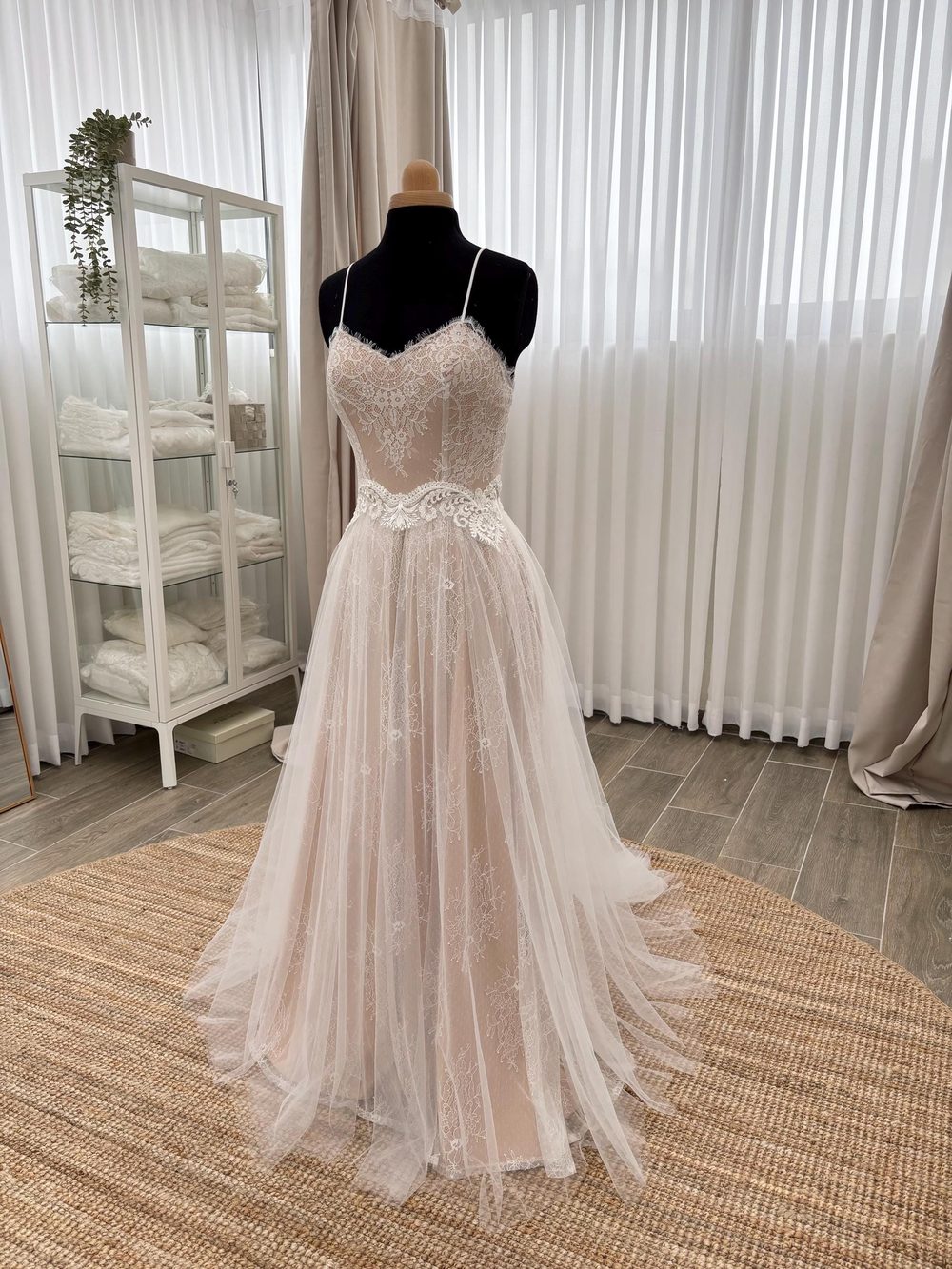
- Feel. Light, airy and almost weightless in a single layer. In six layers over a petticoat, no longer weightless.
- Look. Soft, romantic and luminous in natural light. It photographs beautifully outdoors.
- Drawbacks. It snags on rings, heels and rough surfaces. It tears more easily than any other bridal fabric. It shows every mark.
- Suits. Ball gowns, romantic A-lines, and as an overlay above lace or satin.
Ask whether the tulle is soft (Italian-style, silk-like) or stiff. They are sold under the same name and feel nothing alike.
Satin
A weave rather than a fibre, which is why "satin" can mean silk satin, polyester satin or a blend. What they share is a smooth, glossy face and a heavy, liquid drape.
- Feel. Smooth and cool to the touch, but it does not breathe. In a warm climate that is noticeable.
- Look. Classic, formal, faintly regal. In a straight cut it is the definition of minimalism.
- Drawbacks. It creases. It shows every seam and every ripple. Water spots mark it. It demands precise tailoring and forgives nothing.
- Suits. Sheaths, clean A-lines, and dresses with architectural necklines.
Ask what fibre the satin is. Silk satin drapes and breathes better than polyester and costs more to make; the label rarely says which you are looking at unless you ask.
Mikado
A relative of satin: thicker, with a subtle texture and a matte or semi-matte finish. It holds a shape, which makes it the fabric of structured dresses, pockets, pleats and geometric necklines.
- Feel. Substantial. Not stiff like a board, but it stands where you put it.
- Look. Modern and sculptural. A mikado dress reads as "designed".
- Drawbacks. It is warm, it has weight, and it will not flow. A mikado skirt moves as one piece.
- Suits. Ball gowns with clean lines, structured A-lines, sheaths with a strong shape. Not empire lines, not boho.
Chiffon
A very fine, sheer, lightweight fabric, nearly always used in several layers over a lining.
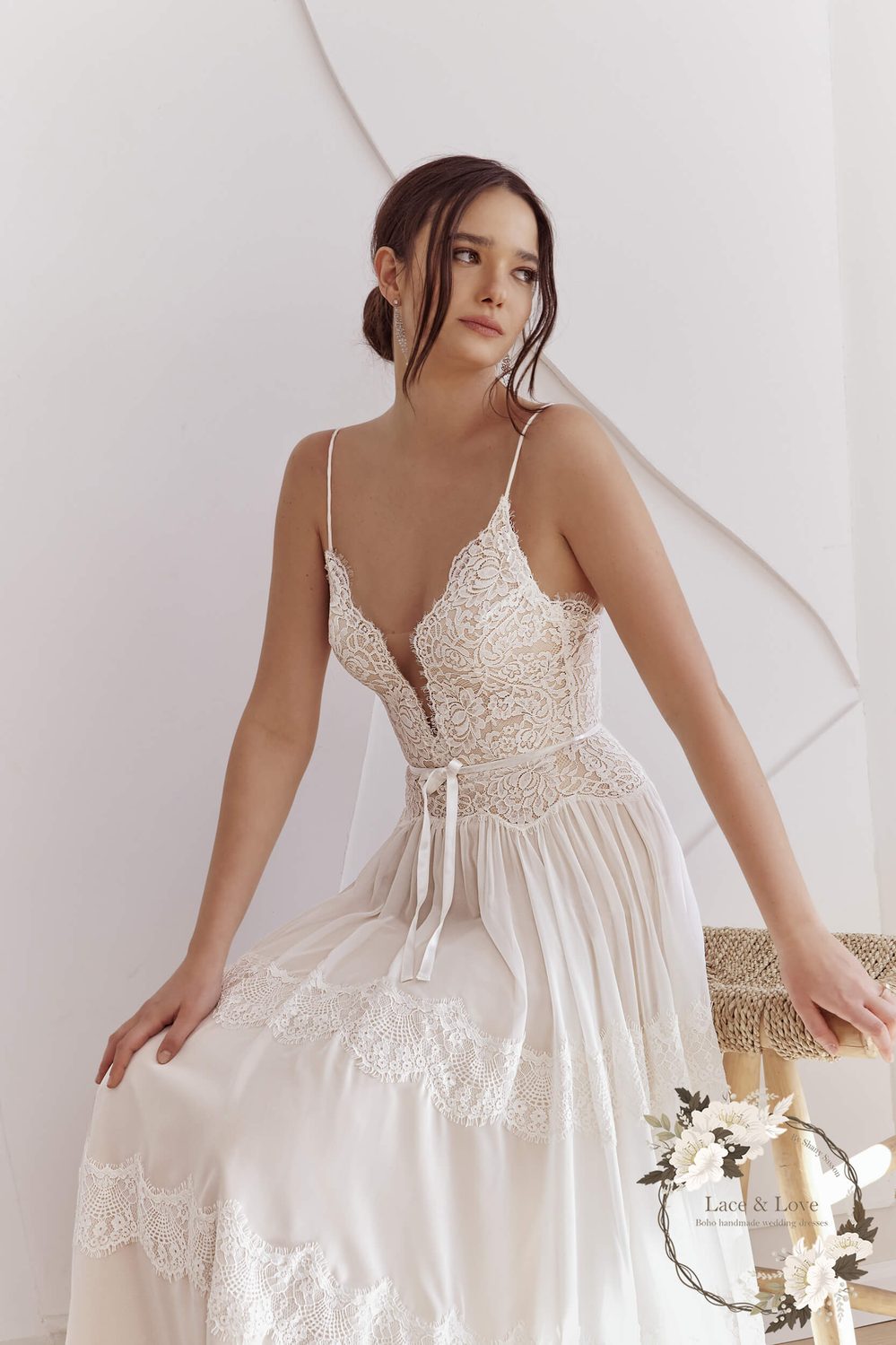
- Feel. The most breathable bridal fabric there is. The natural choice for a summer wedding outdoors.
- Look. Soft, fluid, slightly Grecian. It catches wind and moves with the body.
- Drawbacks. It creases, it drifts in a breeze, and it holds no structure at all. A corseted bodice in chiffon does not work; the chiffon has to sit over something firmer.
- Suits. Empire lines, soft A-lines, boho, beach and destination weddings.
Chiffon and soft tulle are the two fabrics most often confused, because both are light and both float. The difference is that chiffon flows and tulle holds air. Our publisher's studio has a short comparison, chiffon versus tulle on a boho skirt, with the two side by side on finished dresses.
Crepe
A matte fabric with a slightly pebbled surface and, often, a small amount of stretch. It falls straight and clean.
- Feel. Comfortable, forgiving, and cool enough for most climates in a light weight.
- Look. Modern and quiet. The fabric of the minimal, unadorned dress.
- Drawbacks. Heavier crepes hold heat. Because the surface is plain, cut and fit are fully visible.
- Suits. Sheaths, fitted dresses with an interesting back or a slit, trumpets in stretch crepe for brides who want to dance.
Organza
Sheer like chiffon but crisp rather than soft. Where chiffon flows, organza floats and holds air.
- Feel. Light, but with body. It rustles.
- Look. Airy volume without the weight of tulle. It gives a ball gown lift without layers.
- Drawbacks. It creases sharply and creases stay. It can look stiff if used badly.
- Suits. Full skirts that need volume with less weight, overlays, and layered tiers.
Lace
Not a fabric so much as a family. Chantilly is fine and sheer with a scalloped edge. Alençon (French corded lace) has a raised outline around the motifs and feels richer. Guipure is heavy and open, with no net background, and reads as handmade. Embroidered tulle, the most common lace in ready-to-wear, varies enormously in quality between makers.
Lace barely creases, hides well, and is comfortable. It is also the fabric where the gap between the shop sample and the delivered dress is widest, because the same pattern can be made up in laces of very different quality. Our guide to lace types goes into each one.
How do wedding dress fabrics compare?
| Fabric | Weight | Breathes | Creases | Holds shape | Best for |
|---|---|---|---|---|---|
| Tulle | Light (per layer) | Yes | Barely | With structure underneath | Ball gown, romantic A-line |
| Satin | Heavy | No | Yes, readily | Moderately | Sheath, clean A-line |
| Mikado | Heavy | No | Slightly | Strongly | Structured, sculptural cuts |
| Chiffon | Very light | Yes | Yes | Not at all | Empire, boho, outdoor |
| Crepe | Light to medium | Mostly | Barely | Falls straight | Sheath, modern fitted |
| Organza | Light | Yes | Sharply | Holds air | Volume without weight |
| Lace | Varies | Yes | Barely | Depends on base | Almost anything, over a lining |
What should you ask about the fabric?
- Is the dress I am trying on made of exactly the fabric I will receive? In many salons the sample is one fabric and the delivered dress another. Ask to see a swatch of the fabric that will be used, and ask to keep a piece.
- What will the finished dress weigh? Lace over tulle over a petticoat adds up. Ask for a number or ask to lift a finished dress of the same construction.
- Does it breathe, and what lining do you recommend for my season? A thin lining can make a satin dress wearable in summer.
- What happens if it creases on the day? Some fabrics need a steamer within reach. Ask.
- Does this fabric suit the silhouette I want, or should one of them change? A good designer will tell you plainly. The answer is often more useful than anything on a mood board.
Fabric and silhouette are one decision made in two parts. If you have not settled the shape, read the silhouette guide first. If lace is on your list, the lace types guide explains why two lace dresses can look nothing alike.