Lace is the word brides use most and understand least, and that is not their fault. Lace is a fabric made of thread worked into a pattern with open spaces between the motifs. "Lace" covers a family of fabrics that have almost nothing in common beyond being patterned and partly see-through. One is as fine as a cobweb; another is thick, opaque and holds its own shape. A dress described as lace could be either.
This guide takes the five kinds you will meet most often, then turns to the practical questions: why two lace dresses never look alike, appliqué against all-over lace, what to ask about samples, and care.
What is lace, briefly?
Lace is thread worked into a pattern with open spaces between. Nearly all bridal lace today is machine-made, and the names below describe the style rather than the method. What separates one from another is the ground it sits on, the thickness of the thread, whether the motifs are outlined with a cord, and how much open space is left between them.
Chantilly
What it looks like. A fine, flat lace with delicate floral or scrolling motifs on a very fine net. The pattern is drawn with thin thread and often shaded, so it reads as a soft drawing rather than a raised embroidery.
Weight and transparency. The lightest bridal lace and the most transparent. Held up to a window it nearly disappears. It drapes like chiffon.
Where it is used. Full-length sleeves, overlays on skirts and trains, illusion backs, and anywhere the designer wants the lace to move.
How it feels. Almost weightless, slightly cool, and fragile.
Alençon
What it looks like. A floral lace with one distinctive feature: each motif is outlined with a heavier cord, which raises the pattern from the net and gives it definition. The net ground is fine and the motifs tend to be dense and formal.
Weight and transparency. Medium. Heavier than Chantilly because of the cording, and less transparent because the motifs sit closer together. It holds a shape better and drapes less.
Where it is used. Bodices, fitted skirts on mermaid and trumpet dresses, and cut-out appliqué, because the corded edge makes each motif easy to separate from the net.
How it feels. The raised cord is noticeable under the hand. It is more robust than Chantilly and less likely to snag.
Guipure
What it looks like. A lace with no net ground at all. The motifs, usually bold flowers, leaves or geometric shapes, are joined to each other by small bars or plaits, so the pattern is the fabric. Where there is no motif there is a hole.
Weight and transparency. The heaviest of the group and the least transparent within the motifs, though the spaces between them are fully open. It does not drape; it sits.
Where it is used. Fitted bodices, modern and graphic dresses, and panels where the lace is meant to read as texture rather than veil. It is also the usual lace on cotton-based bohemian dresses.
How it feels. Thick, cool and almost sculptural. With no net, it can be lined with anything or nothing, and skin shows through the gaps.
Corded lace
What it looks like. A general term rather than a strict type: any lace whose motifs are outlined with a raised cord. Alençon is the classic example, but many modern laces on a heavier net use a thicker, glossier cord with larger, more open motifs, and that changes the whole look.
Weight and transparency. Medium to heavy depending on the density of the cord. More opaque than Chantilly, less than guipure.
Where it is used. Bodices, all-over skirts on fitted dresses, and appliqué.
How it feels. Textured and firm; ask to sit down in it.
Embroidered tulle
What it looks like. Not, strictly, a lace at all. The pattern is embroidered directly on a tulle base, with thread, sequins, beads or small appliquéd motifs. It can imitate any of the laces above or do something of its own: scattered leaves, raised flowers, geometric lines.
Weight and transparency. Anything from feather-light to heavy, depending on how much is embroidered. Between motifs it is exactly as transparent as the tulle.
Where it is used. Skirts, overlays, sleeves and full dresses that need a pattern a traditional lace could not give. Most contemporary lace dresses with beading are embroidered tulle.
How it feels. Varies with the embroidery. Beaded versions are cool and heavy and can be scratchy inside unless lined.
The five at a glance
| Lace | Ground | Weight | Transparency | Typical use |
|---|---|---|---|---|
| Chantilly | Fine net | Very light | High | Sleeves, overlays, soft dresses |
| Alençon | Fine net, corded motifs | Medium | Medium | Bodices, fitted skirts, appliqué |
| Guipure | None, motifs joined by bars | Heavy | Low within motifs, open between | Bodices, graphic and cotton dresses |
| Corded | Net, raised outlines | Medium to heavy | Medium | Bodices, all-over fitted dresses |
| Embroidered tulle | Tulle | Variable | Variable | Beaded and contemporary dresses |
French lace and the rest
Chantilly and Alençon are named after French towns, and lace from the surviving mills in northern France is still sold as French lace. It is made on old Leavers machines that produce a fine, even net and a pattern that looks drawn rather than stamped.
Lace made elsewhere is not automatically inferior, and much of it is sold under the same style names, which is where confusion starts. The honest distinction is between Leavers lace and the more common Raschel lace, which is knitted rather than woven, has a coarser net, and looks flatter and slightly shinier. If a salon describes a lace as French, ask whether it means the origin or the style.
Why do two lace dresses look nothing alike?
Because "lace dress" fixes almost nothing. Consider what varies: the type of lace, the colour of the lining beneath it, whether the lace is applied over a fitted lining or floats over a soft one, whether the motifs are placed by hand or cut from a roll, the scale of the pattern against the size of the bride, and how much of the dress is covered. A Chantilly overlay on a bias-cut silk slip and a guipure bodice over a structured corset are both lace dresses. They share nothing.
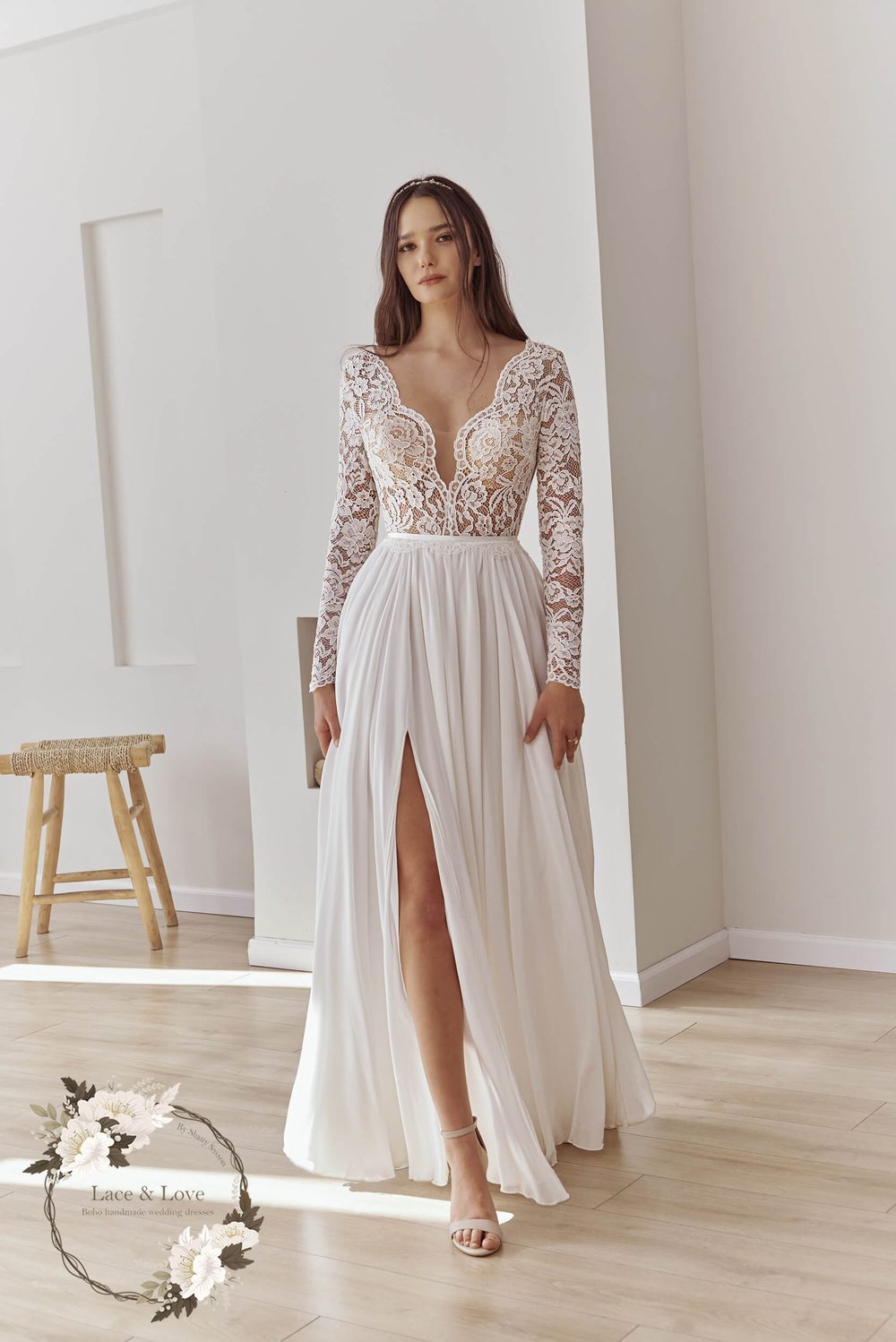
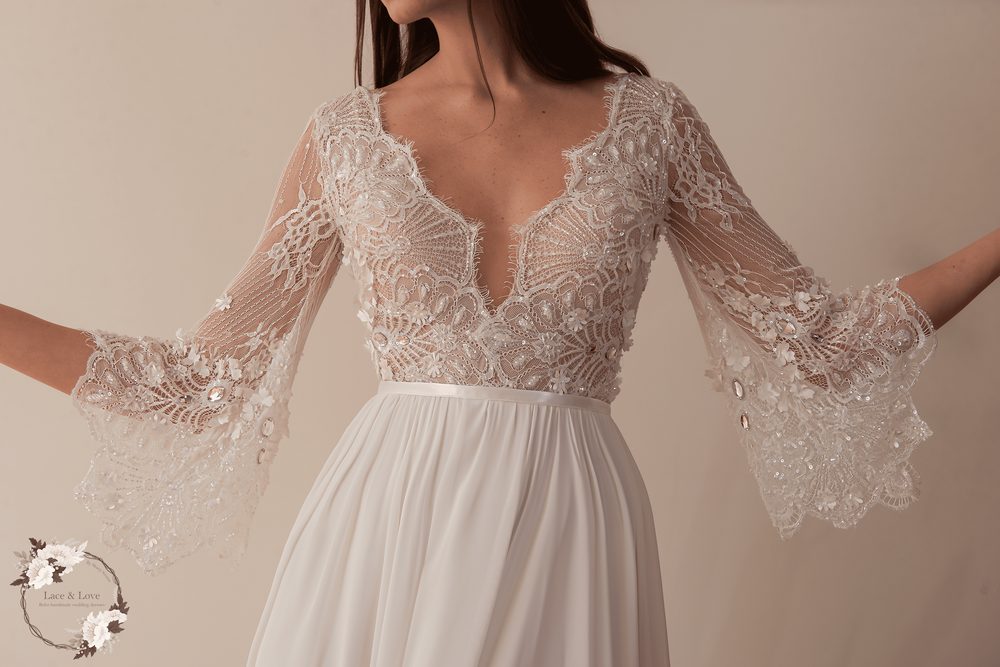
When you save a photograph, work out what you actually like (the fineness of the pattern, the movement, the skin showing through, the graphic outline) and describe that at the appointment.
What is the difference between appliqué and all-over lace?
All-over lace is a length of lace fabric cut like any other fabric and sewn into the dress. The pattern runs continuously and the seams cut through it. It is quicker to make.
Appliqué is individual motifs cut from the lace and hand-placed on a base of tulle or silk. The designer can follow the lines of the body, concentrate motifs at the waist or fade them out toward the hem, and hide seams beneath them. It takes far longer, and it is why some dresses seem to have lace growing across them rather than covering them.
Neither is better. Ask which one a dress is, and if it is appliqué, whether the motifs will be placed on your body at the fitting or on a standard form.
What should you ask before ordering a lace dress?
Is the sample lace the same as the lace on the delivered dress? Salon samples can be several seasons old and mills discontinue patterns. Ask whether your dress will use the same lace from the same mill, and get the answer in writing.
Can I keep a swatch? A small piece of the actual lace, with the actual lining, lets you check colour against your veil and your accessories in daylight at home. Our guide to questions before buying has the rest of the list.
What is under it? The lining changes colour and transparency completely. Ask to see the lace held away from it.
Will spare motifs be kept? So that a tear on the day can be patched afterward.
Care and snagging
Lace catches on everything: rings, bracelets, a fingernail, a chair, a zip. Take rings off when dressing, and ask anyone helping with the buttons to do the same. Sit down on a smoothed skirt rather than a bunched one. If a thread pulls, do not cut it; ease it back with a pin and leave the rest to a professional.
Keep the dress hanging in a breathable bag, never plastic, and away from direct light, which yellows fine net. Afterward, have it cleaned by a specialist rather than a general dry cleaner, and tell them which lace it is. Our cleaning and preservation guide covers the details.
Lace is one fabric among many, and how it behaves depends on what is under it. The fabrics guide covers the silks, crepes and tulles it is usually paired with. For the dresses that use lace most freely, see the boho wedding dress guide. To see several of these laces on finished dresses rather than as swatches, the studio that publishes this journal keeps a full lace collection photographed on real brides.