The dress has one job, and it does it in a day. What happens in the weeks afterwards decides whether it is still white in twenty years or a faintly yellow object in a box. Preserving a wedding dress means cleaning it within weeks of the wedding and storing it away from light, damp and acid so it stays white. This guide covers the day itself (steaming, emergencies), the first week (why it matters more than any other), how professional cleaning differs from a standard dry clean, and how to store the dress properly if you intend to keep it.
On the day: steaming and small emergencies
On the day itself, a handheld steamer and a small kit of white cloth, plain water, chalk and safety pins deal with nearly everything that goes wrong.
Steaming. Most fabrics arrive slightly creased from the garment bag. A handheld steamer, held a hand's width from the fabric and never touching it, resolves most of it. Steam satin and silk from the inside where possible; direct steam can leave water marks on the face. Do not iron anything unless the designer has told you the fabric tolerates it, and never iron tulle, which melts.
A small kit. A white cloth, plain water, a small soft brush, white chalk or baby powder, a safety pin set, and a needle with white thread. That is enough for nearly everything that goes wrong.
Common emergencies, and what actually works:
| Problem | Do | Do not |
|---|---|---|
| Red wine or coloured drink | Blot with a white cloth and plain water from the outside in | Rub, use soap, use anything coloured |
| Makeup on the neckline | Dab with a dry cloth; chalk or baby powder absorbs oil-based marks | Wet it, which spreads foundation |
| Grass or mud on the hem | Let it dry, then brush off gently | Wet it while it is fresh |
| Grease or food | Baby powder or chalk, leave, brush off | Water |
| A loose bead or a popped stitch | Safety pin from the inside, or a few stitches | Glue |
Whatever happens, tell the cleaner afterwards exactly what the stain is. Cleaning is far more effective when the chemistry is known.
Why does the first week after the wedding matter most?
Most of the damage a dress suffers is invisible on the day. Sugar from drinks dries clear and turns yellow over months. Sweat and body oils along the bodice and underarms oxidise. A hem that brushed a lawn holds moisture. None of this shows in the photographs, and all of it is far easier to remove in the first week than in the sixth month.
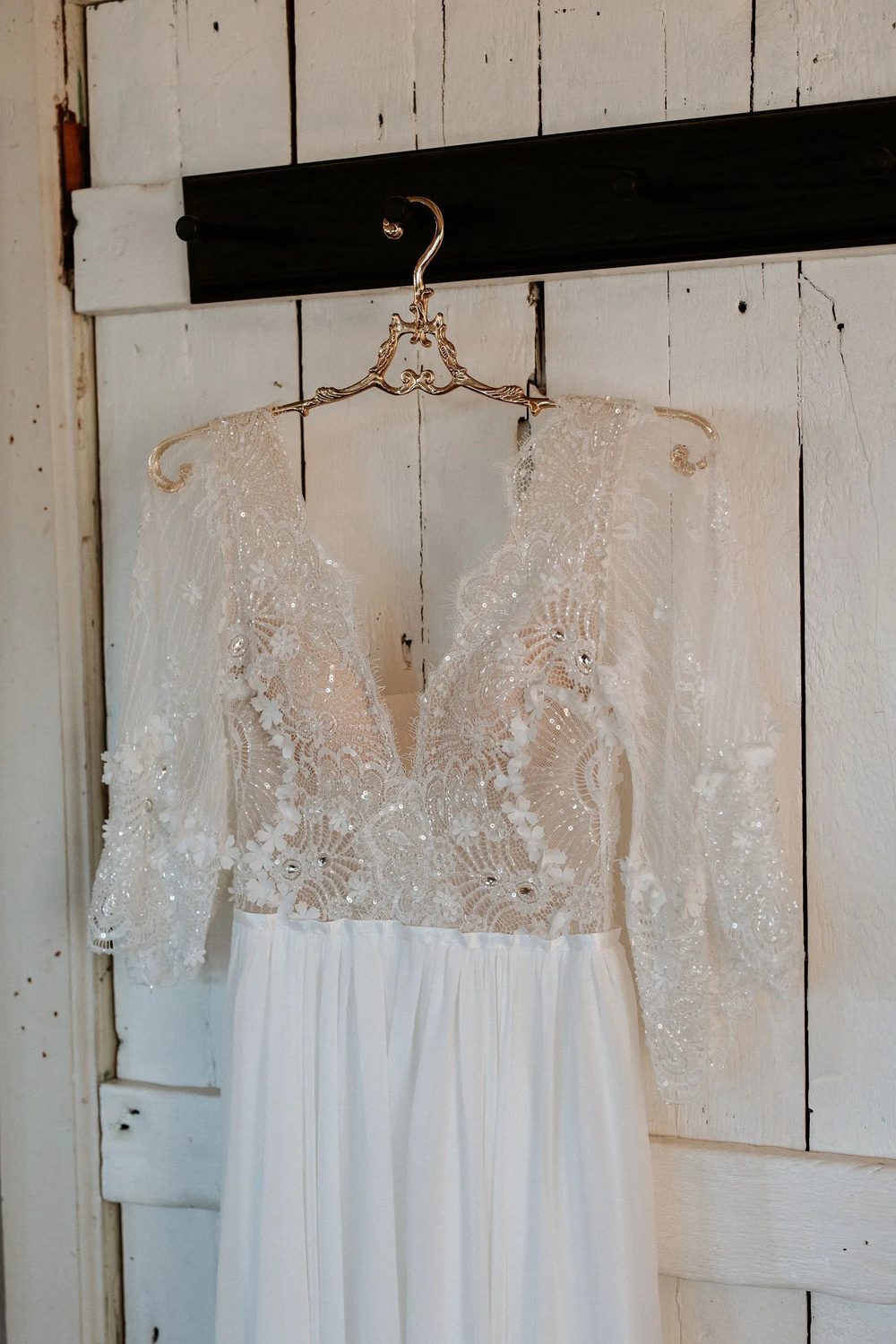
So, within the first few days:
- Hang the dress in a cool, dry room, out of sunlight, not in a plastic bag.
- Note every mark and where it came from.
- Book the cleaning.
If you are travelling straight after the wedding, ask someone to do this for you. It is the one task that cannot wait for your return.
What is the difference between specialist cleaning and dry cleaning?
A standard dry cleaner uses a solvent bath and a tumbling drum. That process is fine for a wool suit and hazardous for a beaded silk dress: solvents can dissolve the glue behind embellishments, dull sequins and strip finish from some silks, and the tumbling can tear tulle.
A specialist wedding dress cleaner does something different. The dress is inspected, stains are identified and treated individually by hand, and the dress is cleaned with a method chosen for the fabric, often wet-cleaning for sugar and sweat stains that solvents do not touch. Beading is protected or removed and re-attached. The dress is finished by hand.
Questions that tell the two apart:
- Do you hand-treat stains before cleaning?
- Do you wet-clean, and when?
- How do you protect beading and appliqué?
- Will you inspect the dress with me before and after?
- Have you cleaned this fabric before?
A cleaner who cannot answer these is a dry cleaner with a wedding sign in the window.
How should a wedding dress be stored?
If you intend to keep the dress, the enemies are light, humidity, acid and creasing.
Box, not bag. An acid-free archival box, with the dress folded in acid-free tissue and tissue rolled into every fold so nothing creases sharply. The box goes somewhere cool, dark and dry: a wardrobe in a bedroom, not an attic (heat) or a basement (damp).
Not plastic. Plastic garment bags trap moisture and can yellow fabric over years. If the dress must hang for a while, use a breathable cotton bag.
Not vacuum sealed. It creases permanently, and any moisture inside stays inside. Some cleaners offer sealed preservation boxes; ask whether the seal is airtight and what happens if you want to open it. Most conservators prefer a box you can check.
Hanging versus folding. Heavy dresses hung for years stretch at the shoulders and straps. Folding with tissue is safer for long-term storage. If you hang, use a padded hanger and loops sewn into the side seams, never the straps.
Check it. Once a year, open the box with clean hands, look for yellowing or marks, and refold along different lines. A dress that is looked at is a dress that is kept.
What if you do not intend to keep the dress?
Cleaning is still the first step. A clean dress can be sold, donated, altered into something else, or passed on. A stained one, after a year, often cannot. Whatever the plan, the first week is the same.
What the dress is made of decides how it should be cleaned and stored; the fabrics guide covers each material. And the twelve questions to ask before buying includes one about cleaning and storage, because it is far easier to arrange before the wedding than after.