An open back wedding dress is a dress cut away below the shoulders at the back, so that the skin is visible from the neck or shoulder blades down to a point somewhere between the bra line and the natural waist. The opening can be bare, or covered with sheer illusion tulle and lace so that the back reads covered from a distance and open up close. The style is beautiful because the back is the one part of a dress that is seen without the bride knowing, walking down the aisle and standing at the front. It is also the style that raises the most practical questions, all of which come down to one: what holds it up. This guide sets out the back styles, answers that question honestly, and covers fabrics, the sit-and-bend test, veils and hair, and what to ask before you order.
What counts as an open back on a wedding dress?
Any back cut lower than a standard scoop or V counts, and the distinction that matters is bare or illusion. A bare back leaves the skin open and finishes the edge of the fabric with a firm facing or elastic tape so it stays flat against the body. An illusion back fills the opening with skin-tone tulle, usually with lace laid over it and often closed by a row of covered buttons down the spine. Both are cut on the same bodice and both are supported the same way, from the front. The difference is in the finish: an illusion back gives the seamstress a surface to anchor the closure and to stop the edges of the opening pulling away from the skin, and it photographs as pattern rather than as skin, which some brides want and some do not. The depth is measured from the nape to the lowest point of the opening, and the natural waist is the practical limit for a bodice that still has to hold its shape when you sit.
Which back styles are there, and how low does each go?
Six styles cover nearly every open back sold, and each one goes to a different depth and leaves room for a different kind of support.
| Back style | How low it goes | What it looks like | Support it allows |
|---|---|---|---|
| Low scoop | To the waist or just above | A smooth U or oval of bare skin | Sewn-in cups and front boning only |
| V back | From the shoulders to a point at the bra line, mid back or waist | Sharp lines that draw the eye down | Front boning; a low-back converter if the point stops above the bra line |
| Keyhole | A closed opening between the shoulder blades, fastened at the neck | A window of skin framed by fabric | Almost anything, including a bra with a low band below the opening |
| Illusion lace back | To the waist, covered in sheer tulle and lace | Skin through pattern; covered from a distance | Sewn-in cups; the tulle carries no weight |
| Button-up lace back | To the waist, sheer lace closed by covered buttons down the spine | Vintage, the button line the main feature | Sewn-in cups; the closure adds a little hold |
| Cowl back | Below the shoulder blades, fabric draped loosely across | Soft folds with bare skin above | Front support only; the drape hides nothing beneath it |
A back to the waist is the most requested and the most demanding. Anything lower needs the skirt to start higher at the back than at the front and will gape when you sit unless the bodice is very firmly fitted.
What actually holds an open back dress up?
The front of the bodice does, and nothing else. A properly made open back dress has three things built into it. Cups, foam or moulded, sewn into the lining at the bust. Boning, spiral steel or firm plastic, running in channels through the front and side panels of the bodice so it cannot fold or slide. And a waist stay, a firm grosgrain band sewn inside at the natural waist and fastened separately, which carries the weight of the skirt so that the bodice does not have to. With these three, the dress stays exactly where it was fitted, and what you wear underneath is a matter of comfort rather than support.
The alternatives are weaker, and it is better to know that now. Adhesive cups give shape but no lift, they loosen in heat and with sweat, and they are for one wear. Low-back bra converters, a strap that hooks to a normal bra and passes around the waist to pull the band down, work for a V that stops above the bra line and not much lower; below that the band shows or the strap digs into the waist, and the pull that lowers the band also lowers the cups. For any back cut to the mid back or the waist, the support must be sewn in. Brides with a fuller bust should ask for a full corselet, which is a boned inner bodice, rather than cups alone. The guide to what to wear under a wedding dress covers the underwear side.
Which fabrics suit an open back?
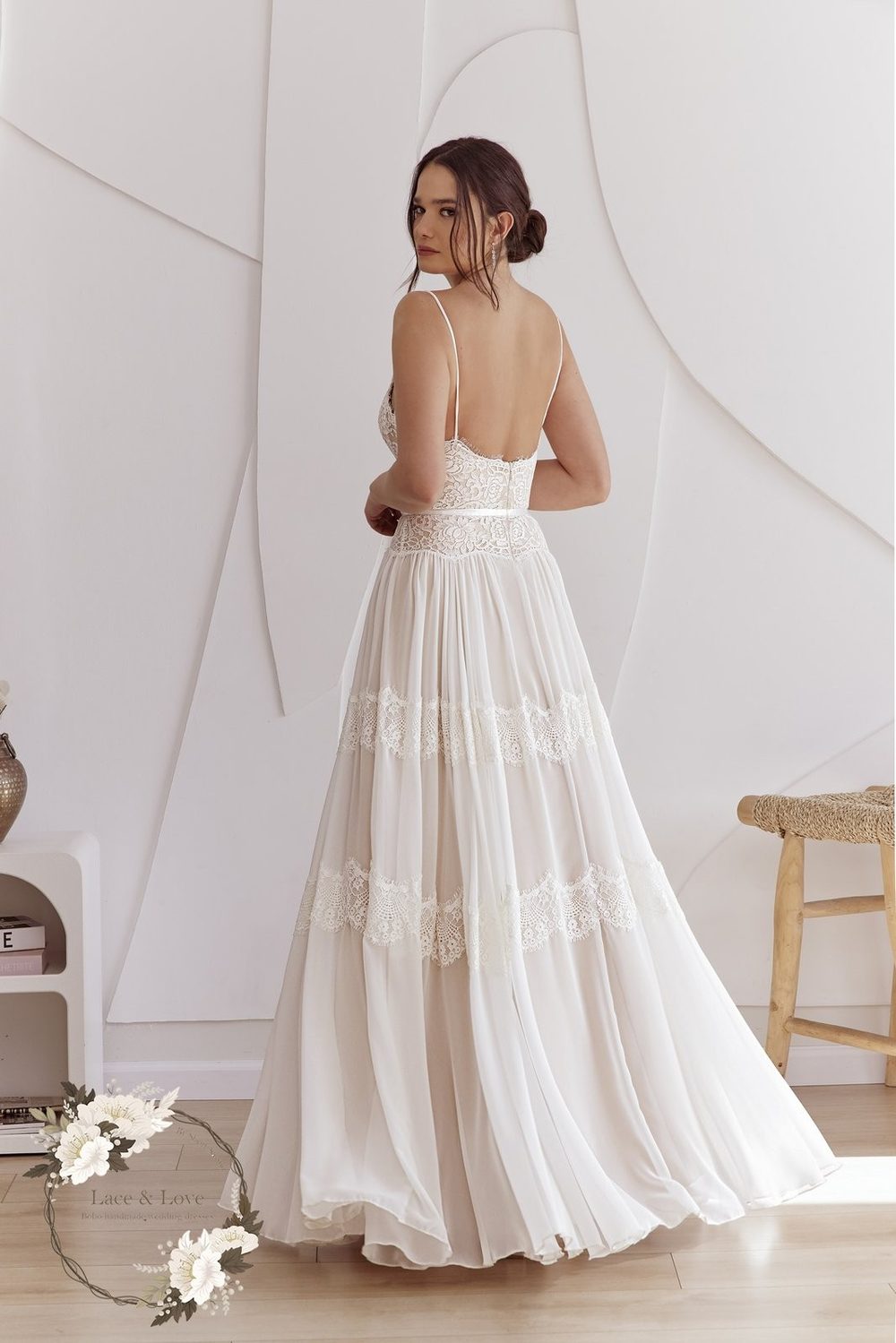
Lace over illusion tulle is the easiest fabric to make an open back in, and crepe is the hardest. The tulle gives the opening a structure: the lace motifs can run across it, the buttons can close along it, and the edges of the bodice have something to hold them flat. A bare back in lace works too, but the scalloped edge of the lace has to be finished so it does not curl away from the skin. Crepe gives the cleanest open back of all, a single smooth line of fabric against skin, and it forgives nothing: every mark of underwear shows through it, every wrinkle at the waist shows, and the edges must be faced with a firm tape or they ripple. Chiffon is not a bodice fabric on its own. Most chiffon dresses with an open back have a lace or crepe bodice that carries the structure and a chiffon skirt that hangs from the waist stay, which is exactly the combination in the photograph above. Satin and mikado hold a low back well because they are firm, but they are warm and they crease when you sit.
How do you test an open back at a fitting?
Sit down, lean forward, bend to pick something off the floor, hug someone, raise your arms, and then look at the back in a mirror. This is the sit-and-bend test, and it finds every problem an open back can have. Watch four things. The front of the bodice: if it drops or gapes at the bust when you lean forward, the cups or boning are not doing their work. The edge of the opening: if it lifts away from the skin when you sit, the edge needs a firmer facing or a little elastic. The side seams: if they swing towards the back when you bend, the waist stay is not tight enough. And the waist stay itself: it should be firm and not dig. Do the test in the shoes you will wear, because heel height changes your posture and with it the way the bodice sits. Do it at the first fitting, when the fix is a seam, and again at the last, when the fix is a hook.
How do a veil and hair work with an open back?
Decide first when you want the back to be seen. During the ceremony, guests see the back for longer than any other view, and a veil covers it. A single-tier veil in the sheerest tulle shows the back through it; a veil pinned at the nape rather than the crown leaves the upper back open; and the simplest answer is to remove the veil after the ceremony so the back is visible at the reception and in every photograph taken afterwards. The veil lengths and accessories guide explains how each length falls. Hair follows the same logic. Hair worn up shows the whole opening; hair worn down covers the top third of it and, in a low scoop, ends the line early. A low bun or a side sweep is the usual compromise. Ask your photographer for one back view during the processional, since that is the moment the back is fully seen and nobody thinks to photograph it.
What one studio makes. In the studio that publishes this journal, 23 of the 50 dresses currently in the collection have an open or illusion back, the single most requested detail in made-to-measure orders, and nearly all of them are cut with the support sewn into the front of the bodice rather than relying on underwear.
What to ask before you order
- How is this dress held up, and can you show me the cups, the boning and the waist stay inside the sample?
- How low does the back go on me, measured from the nape, and where does the waist stay sit?
- Is the back bare or illusion, and if illusion, what shade is the tulle against my skin?
- Can I do the sit-and-bend test in the sample now, in shoes of the height I will wear?
- If I need more support, can the bodice be made with a full corselet?
- How is the back edge finished so that it stays flat against the skin all day?
What goes under an open back is a question of comfort once the support is built in, and the guide to what to wear under a wedding dress goes through the options. A veil changes when the back is seen, which the veil lengths and accessories guide covers. To see low scoop, V and illusion backs on finished dresses, the studio that publishes this journal keeps its open back wedding dresses in one collection.