A long sleeve wedding dress is a dress whose sleeves reach the wrist or close to it, whether the sleeve is fitted lace over a skin-tone lining, a full bishop gathered into a cuff, a flared bell, a sheer illusion tulle with lace laid on top, or a detachable piece worn for the ceremony and taken off for the dancing. The sleeve decides more than how covered you are. It changes the shoulder line, how far you can lift your arms, how warm you will be, and which necklines remain open to you. This guide sets out the sleeve types, the fabrics that let you move, the one test to do at a fitting, and how to choose for the season and the venue.
What counts as a long sleeve on a wedding dress?
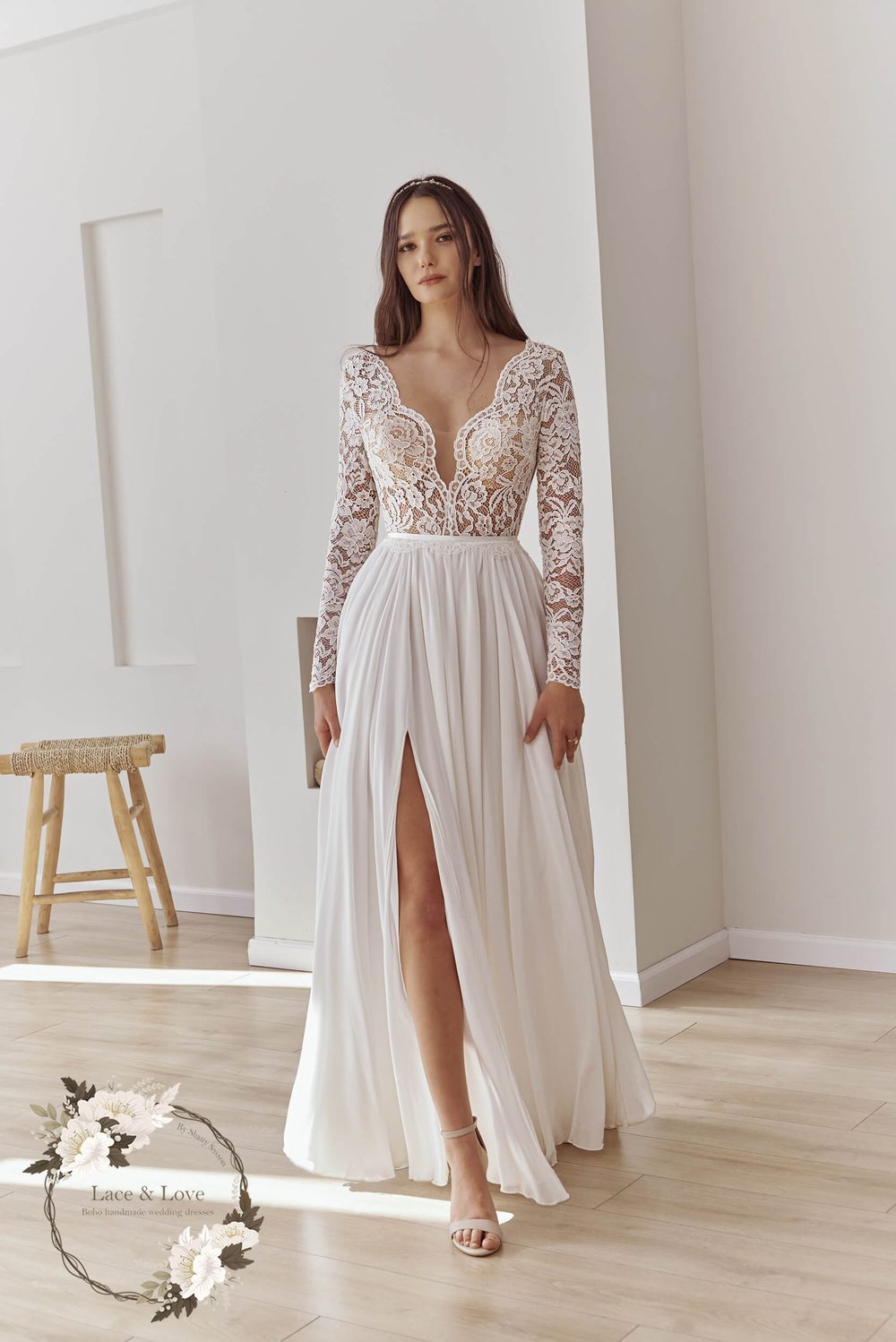
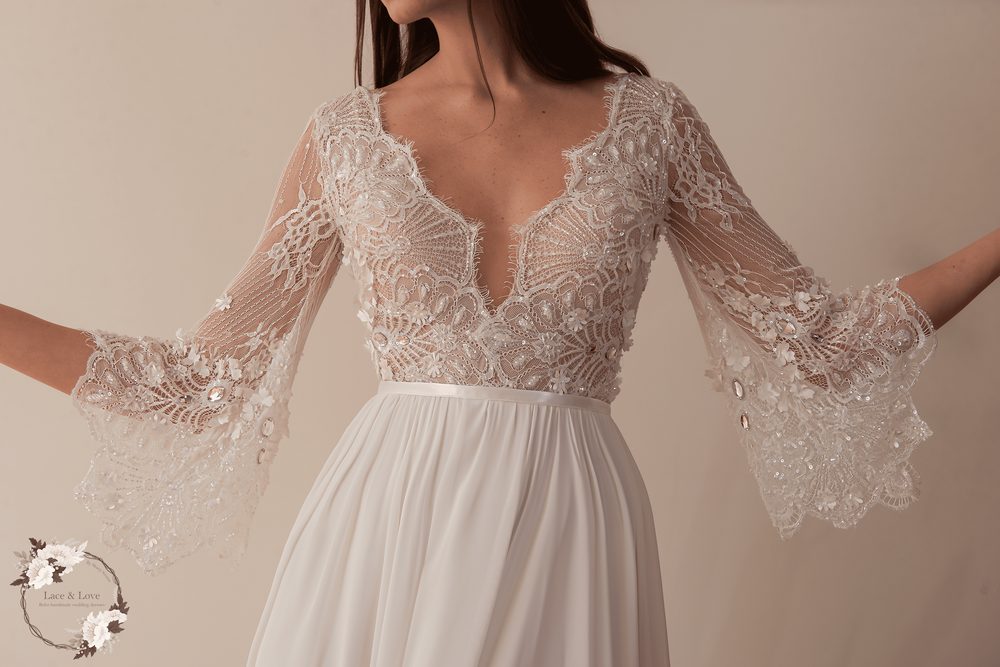
Any sleeve that ends at or near the wrist counts as long. A sleeve that ends between the elbow and the wrist is three-quarter, and salons group the two together because they are cut, lined and fitted in the same way. What separates the styles is volume and fabric rather than length. A fitted sleeve follows the arm closely and reads as a covered arm. A bishop sleeve is cut full through the arm and gathered into a fitted cuff. A bell sleeve is narrow at the shoulder and widens towards the hand without a cuff. An illusion sleeve is sheer tulle, usually with lace motifs appliquéd on top, so the skin shows through the pattern. A detachable sleeve is any of these fastened to the armhole with hooks or small buttons rather than sewn in. Most made-to-measure studios will make any of the five on most bodices, so treat the sleeve as a choice layered onto the dress rather than a fixed part of it.
Which sleeve types are there, and what does each do to the shoulder line?
Each sleeve moves the eye differently and restricts the arm to a different degree. The fitted sleeve restricts most per centimetre of fabric, because it has no ease to give; the bishop restricts least, because its fullness absorbs every movement before the bodice feels it.
| Sleeve | Shape | Effect on the shoulder line | Movement |
|---|---|---|---|
| Fitted lace | Follows the arm to the wrist | Narrows the shoulder, lengthens the arm | Restricted unless cut with stretch, a gusset or a lowered armhole |
| Bishop | Full through the arm, gathered into a cuff | Softens the shoulder, adds volume below it | Free; the fullness moves before the bodice does |
| Bell | Slim at the shoulder, flaring to the wrist | Keeps the shoulder narrow, adds width at the hand | Free at the shoulder; the flare catches on tables, glasses and hugs |
| Illusion tulle | Sheer, skin visible, lace on top | Barely changes the line; reads as a patterned bare arm | Moderate; tulle gives a little, the lace on it does not |
| Detachable | Any of the above, fastened at the armhole | Whatever the ceremony sleeve gives, then a bare shoulder | Whatever the sleeve allows until it comes off |
The shoulder seam matters as much as the sleeve. A seam that sits exactly on the shoulder point gives the cleanest line and the most lift; a dropped shoulder softens the look and costs several centimetres of reach.
Which fabrics work for long sleeves, and which get hot?
The coolest sleeves are Chantilly lace and illusion tulle; the warmest are crepe and corded lace. Chantilly is a flat, fine lace with no raised outline, so it weighs almost nothing and lets air through the pattern. Over a thin skin-tone lining the arm reads covered from a distance and sheer up close, and the lining itself is usually a stretch mesh that breathes. Corded lace, of which Alençon is the best known, has a raised cord around each motif. It holds its shape and photographs with more depth, but it is heavier, stiffer at the elbow and warmer, and it is the lace most likely to need a gusset. Chiffon is the natural fabric for bishop and bell sleeves: it is sheer, it moves, and it is cooler than bare skin in direct sun because it shades the arm. Crepe gives the clean, opaque, classic sleeve, and it is the least forgiving. It has no pattern to hide strain, it holds warmth, and it must be cut with a little stretch or with precise ease at the elbow or it will not bend. Illusion tulle on its own is the lightest option of all and is the base most appliquéd sleeves are built on. The lace types guide describes each lace in more detail.
How do you test a sleeve at a fitting?
Raise both arms straight above your head, then out to the sides, then forward as if holding a bouquet, then bend your elbows as if eating, then hug someone. This is the arm-raise test, and it takes a minute. Watch three things in the mirror while you do it. The waistline: if the bodice lifts when your arms go up and does not settle back on its own, the armhole is too high or the sleeve too tight. The neckline: a sleeve that pulls the neckline up towards the throat, or drags an off-the-shoulder edge inward, needs more ease across the back. The back of the shoulder: fabric pulling into diagonal lines from the armhole means the sleeve is cut too straight for your shoulder.
The fixes are all ordinary. A gusset under the arm, a slightly lower armhole, a stretch lining under the lace, a little extra width across the back. They are easy at the first fitting and awkward at the last, so do the test at the first fitting and again once the sleeve is finished. The fittings guide explains what each appointment is for.
Which seasons and venues suit long sleeves?
Long sleeves suit autumn and winter without argument, and they suit summer more often than brides expect, provided the fabric is chosen for it. A Chantilly or illusion sleeve over stretch mesh, or a chiffon bishop, is comfortable in a warm church, a shaded garden or an evening ceremony. A crepe or corded lace sleeve in an outdoor midday ceremony in July is not, and no amount of wanting the look will change how the fabric behaves. Religious venues that ask for covered shoulders are the most common practical reason for a sleeve, and a detachable sleeve or a lace bolero solves that without committing the whole day to it. Indoors, air conditioning tends to make a sleeved dress comfortable and a strapless one cold, which is worth remembering for a winter hotel reception. For outdoor summer weddings, the honest choice is a light sleeve or a detachable one.
How does a sleeve change the neckline?
A sleeve has to attach to something, so the neckline is decided partly by the sleeve. A fitted or bishop sleeve pairs with any neckline that reaches the shoulder: V, scoop, square, bateau, high neck. A strapless neckline cannot carry a sleeve on its own, so a dress that looks strapless from across the room and has long sleeves up close is built one of two ways. Either the sleeve is illusion tulle that continues up into a sheer yoke over a sweetheart or straight bodice, or the sleeve is detachable and fixed to the edge of the bodice with hooks. Off-the-shoulder long sleeves are the most restricting combination on this page, because the sleeve is anchored below the shoulder and every lift of the arm pulls the neckline down. If you want that look, ask for the sleeve to be attached with a clear elastic band under the arm, or accept that your arms stay below shoulder height until the sleeves come off.
What one studio makes. In the studio that publishes this journal, 17 of the 50 dresses currently in the collection are made with long sleeves, and most of them are lace over a skin-tone lining so the arm reads covered but not heavy. Bishop and bell sleeves in chiffon are the next most common, and nearly every sleeved design can be ordered with the sleeve made detachable.
What to ask before you order
- Is the sleeve sewn in or detachable, and if detachable, what does the bodice look like without it?
- Which lace or fabric is the sleeve made from, and can I hold a swatch against my skin in daylight?
- Is there a lining under the lace, and in what shade? A skin-tone lining reads as sheer; an ivory one reads as solid.
- Will there be a gusset or stretch in the sleeve, and can I do the arm-raise test on the sample now?
- Where does the shoulder seam sit, and can it be moved?
- If the sleeve is corded lace or crepe, how warm will it be at my venue in my month?
The lace that makes up most long sleeves is described in the lace types guide, and the fittings guide covers where the arm-raise test fits into the sequence of appointments. To see fitted, bishop and illusion sleeves on finished dresses, the studio that publishes this journal keeps its long sleeve wedding dresses in one collection.