A train is the part of a wedding dress that extends behind the hem and trails on the floor. Its length is measured from the point where the back hem would fall without a train to the tip of the train, and the standard lengths run from a sweep of a few centimetres to a royal train of three metres or more. The length decides how you walk, who has to help you, what the venue must allow, and what happens to the dress after the ceremony. This guide sets out each length with its typical measurement, the three ways to bustle a train, and how to decide whether you want one.
What are the standard wedding dress train lengths?
There are five standard lengths, plus one type defined by where it attaches rather than how long it is. Measurements vary a little between makers, so treat the figures as typical rather than exact.
| Train | Typical length beyond the hem | Reads as | Needs |
|---|---|---|---|
| Sweep (brush) | 15 to 30 cm | A hint of a train | Nothing; no bustle required |
| Court | 30 to 45 cm | Modest, formal | A single-point bustle, or none |
| Chapel | 90 to 120 cm | A proper train | A two- or three-point bustle |
| Cathedral | 180 to 230 cm | Grand, formal | A multi-point bustle, a helper on the day, a long aisle |
| Royal (monarch) | 300 cm and more | Ceremonial | A helper throughout, usually detachable |
| Watteau | Any length, attached at the shoulders | Cape-like, 18th century | Usually detachable; cannot be bustled from the waist |
Which train length suits which wedding?
The venue decides more than the dress does. A long train needs a long, clean floor to be seen and a moment when it can be spread out for the photographs.
Sweep and court suit outdoor weddings, city ceremonies, registry offices, small venues and any bride who wants to move freely all day. On grass, sand or gravel they are the only lengths that stay clean.
Chapel is the most common choice for a formal indoor wedding: a church, a hall, a hotel. It reads clearly as a train from the back and in photographs, and it bustles into a manageable skirt for the reception.
Cathedral and royal belong to long aisles, high ceilings and weddings with a helper who is responsible for the train, because the bride cannot manage it alone. They are also the lengths most often regretted after the first dance, which is why many are now made detachable.
How is a train bustled?
A bustle is a set of hooks, buttons or ribbons sewn into the dress during alterations that lifts the train off the floor after the ceremony. There are three styles.
Over-bustle (American). The train is lifted up over the outside of the skirt and hooked to points on the back of the dress. It shows the fabric of the train as a gathered fold. Fast to do and easy to repair if a hook goes.
Under-bustle (French). The train is folded up under the skirt and tied with ribbons inside, so the outside of the dress stays smooth. The most invisible style, and the one that suits lace and plain fabrics best. Slower to do and harder to fix in the dark.
Ballroom bustle. The whole train is lifted and tucked so that the hem falls level all the way round, as if the dress never had a train. Uses several points and takes the longest, but gives complete freedom to dance.
A chapel train takes two to four bustle points; a cathedral train can take eight or more. Whoever will do it on the day should be at the final fitting and should film the seamstress doing it.
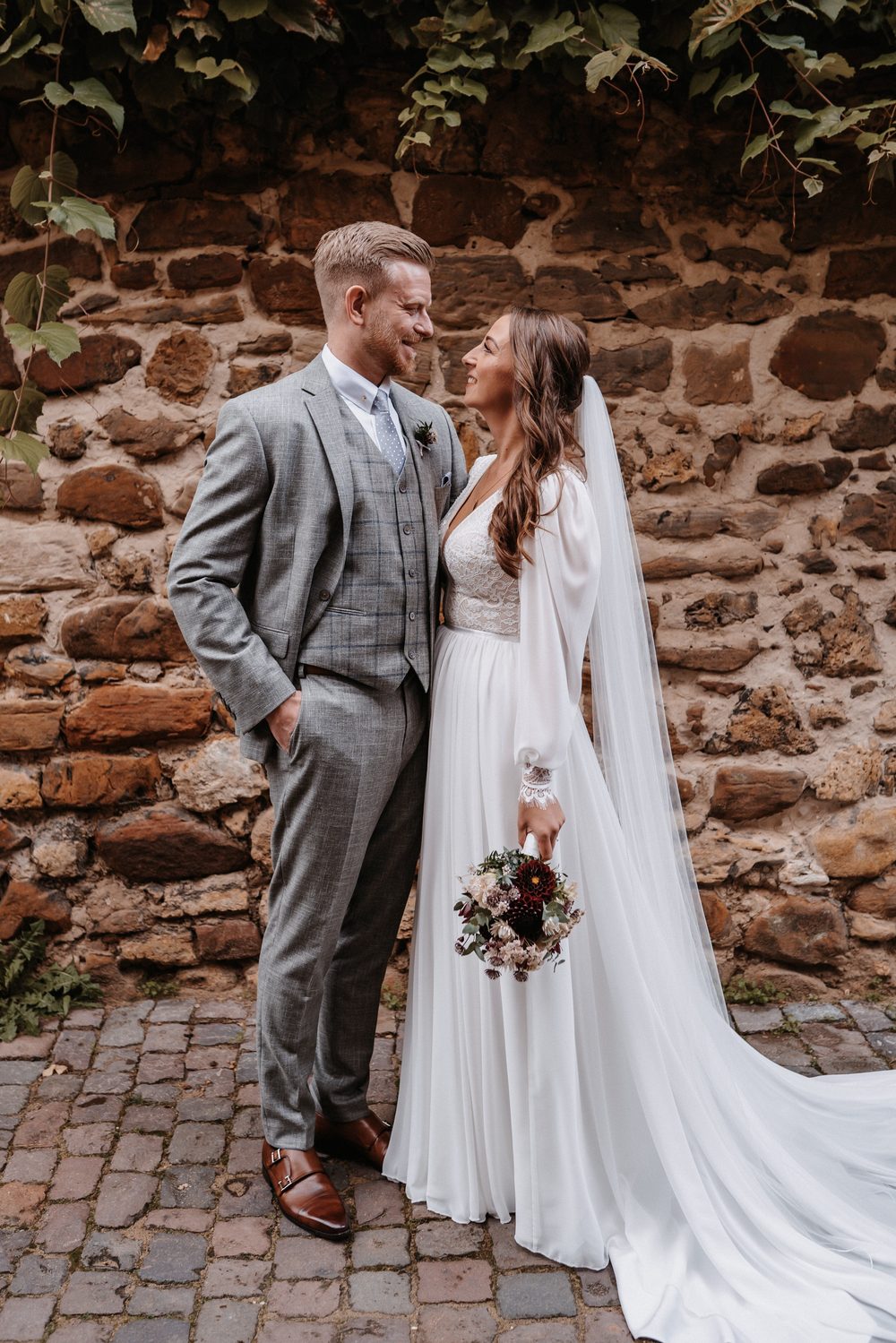
Should you have a train at all?
Not every dress needs one, and the honest test is what you want to do between the ceremony and the last dance. A train is beautiful for the walk down the aisle and the formal photographs, and a burden for everything after, unless it is bustled well or removed.
Three questions settle it:
- Where is the ceremony? Grass, sand, cobbles or stairs argue for a sweep or a detachable train.
- Who will manage it? A cathedral train needs one person whose job it is. If you do not have that person, choose shorter.
- How much of the evening is dancing? The more you plan to dance, the more the train needs to disappear, which means a ballroom bustle or a detachable train.
What brides at one studio choose. In the studio that publishes this journal, 9 of the 50 dresses currently in the collection are offered with an optional train, and in every case the train is a separate choice added at ordering, not part of the base design. In practice most brides ordering made to measure ask for a sweep or a short chapel that can be bustled with two points, and the long trains are chosen almost only for indoor venues with a long aisle.
What to ask before you order
- How long is the train, measured from the back hem?
- Is it cut into the skirt, or detachable?
- How many bustle points will it need, and is the bustle included in alterations?
- Which bustle style suits this fabric? Lace hides an under-bustle; satin shows every fold.
- Can the train be shortened before the wedding if I change my mind?
- Will someone teach my helper to bustle it, and can we film it?
Train length is one part of the silhouette decision; the silhouettes guide covers the rest. A train also changes what happens at the last two fittings, which the fittings guide walks through. To see sweep and chapel trains on finished dresses, the studio that publishes this journal shows each design with and without its train.