Most body shape guides start with fruit. You are an apple, a pear, an hourglass, or, if the writer is feeling generous, a rectangle. Then a list follows: apples wear this, pears wear that. A body shape guide, done properly, matches dress silhouettes to the proportions of the body: shoulders, hips, waist and height. The labels feel scientific and they are nearly useless, because almost nobody is one shape, and because they hide the actual questions a good fitter is asking when she looks at you.
This guide drops the labels. Instead it looks at three relationships in the body, then at height, then at what changes during pregnancy. At the end there is a table, and a reminder that the table is where you begin and not where you finish.
Why do the fruit body-shape labels fail?
Three reasons.
They describe one feature and ignore the rest. "Pear" says your hips are wider than your shoulders. It says nothing about whether your waist is defined, where it sits, or how long your legs are, and those three things change the advice completely.
They are aesthetic verdicts in disguise. An apple is a body to be hidden, a pear a body to be balanced, an hourglass a body to be shown. A fitter does not need to know what to hide. She needs to know where the dress should be fitted and where it should let go.
They ignore height. A tall pear and a petite pear look different in the same skirt.
So the more useful approach is to look at the body the way a pattern cutter does: as a set of relationships rather than as a category.
Which three body relationships matter for a wedding dress?
The three relationships that decide which dress suits you are shoulders against hips, how defined the waist is, and where the natural waist sits.
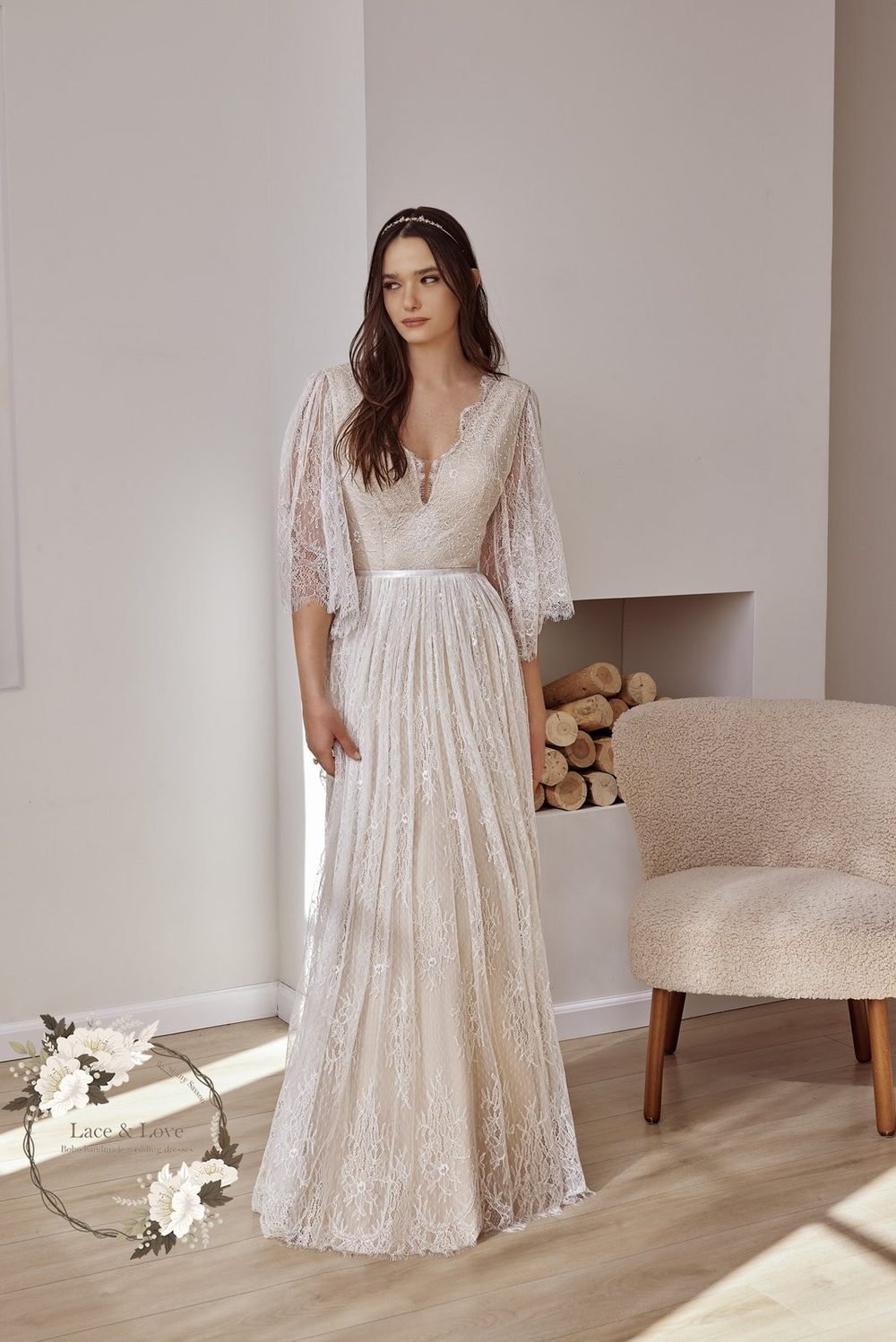
Shoulders against hips
Stand in front of a mirror in something fitted and compare the width of your shoulders with the width of your hips. There are three possibilities: shoulders wider, hips wider, roughly equal.
Shoulders wider. The bodice is doing most of the work here. Necklines that draw the eye inward and down (a V, a deep scoop, a halter with a narrow strap) narrow the shoulder line. Skirts with some volume, an A-line or a soft ball gown, add width below to balance the frame. Off-the-shoulder styles and wide boat necks widen the shoulders further; some brides like that, but go in knowing it.
Hips wider. The skirt is the decision. An A-line that flares from the natural waist glides over the hips without stopping at them. A mermaid or trumpet, which is fitted through the hips, will show them, which is either exactly what you want or exactly what you do not. Bodice details (a wider neckline, a small sleeve, a beaded shoulder) draw attention upward and even the proportions.
Roughly equal. Most silhouettes work; the decision moves to the next two relationships.
How defined the waist is
Look at the difference between your waist and your hips. A pronounced difference means a fitted bodice will show a small waist without any help. A slight difference means the dress has to make the waist rather than reveal it.
A defined waist suits anything fitted at the natural waist: A-line, ball gown, trumpet, mermaid. The risk is the opposite one. An empire line or a loose sheath hides a waist you may want to keep.
A less defined waist benefits from a dress that creates a waist by contrast. A full skirt starting at the waist makes anything above it look narrower. A bodice with seaming that curves inward, a belt or a sash, or a slightly dropped V-shaped waistline all do the same job. A sheath that falls straight from the bust is the least helpful choice, unless the fabric has enough body to be shaped by darts.
Where the natural waist sits
This is the relationship nobody puts on the chart, and it matters as much as the other two. Find your natural waist (bend sideways; the crease is it) and notice how far it sits from the underarm and from the hip bone. A short torso has a high waist and a long leg line. A long torso has a low waist and comparatively shorter legs.
A high waist looks best with the dress waistline dropped slightly below natural, or with a basque waist that dips to a V. A dress fitted exactly at the natural waist can make the top half look cramped. Empire lines, which raise the waist further, are usually the wrong direction.
A low waist looks best with the waistline at the natural waist or a touch above it, which lengthens the leg. A dropped waist lowers the line further and can make the legs look short. Empire lines and raised A-lines are natural friends here.
Ready-to-wear dresses have a fixed waist position, and moving it is a serious alteration. Made-to-measure work places it where your body wants it.
Putting the three together
The table below is not a rulebook. It is a way of narrowing three or four silhouettes to try first.
| Relationship | Try first | Try with care |
|---|---|---|
| Shoulders wider than hips | A-line, ball gown, V or scoop neckline | Off-the-shoulder, wide boat neck, straight sheath |
| Hips wider than shoulders | A-line, trumpet with a high flare, detailed bodice | Mermaid, narrow skirt with a plain bodice |
| Defined waist | Anything fitted at the natural waist | Empire, loose sheath |
| Less defined waist | Full skirt from the waist, basque waist, sash | Straight sheath in soft fabric |
| High natural waist | Waistline at or just below natural, basque | Empire, raised waist |
| Low natural waist | Waistline at natural or slightly raised, empire | Dropped waist |
Read across your own three lines. Where they agree, you have your starting point. Where they conflict (wide hips and a low waist, say), the fitter will need to balance one against the other, and that conversation is far more productive when you both know which relationships are in play. Our guide to silhouettes explains what each of those shapes does once you are in it.
How does height change the choice?
Height changes proportion, not shape, and it changes it in predictable ways.
Petite brides (broadly, under about 160 centimetres) are shortened by volume and by horizontal lines. A heavy ball gown, a dropped waist, a wide belt and a tea-length hem all take height away. A-line, sheath and trumpet silhouettes, a waistline at or slightly above natural, vertical seaming and a modest train all give it back.
Tall brides have the opposite freedom. Volume, drama and horizontal detail all sit well, and a dropped waist or a long bodice looks intended rather than accidental. The one common complaint is that ready-to-wear skirts are too short to allow a proper hem, so check the finished length before ordering.
Pregnant brides
If you will be pregnant on the day, the question changes from "what suits me" to "what will suit me on a body I cannot yet see". A few things help.
Choose a silhouette that expects change. Empire lines and soft A-lines with a raised waist fall from under the bust and do not depend on a waist measurement. A fitted bodice at the natural waist is a gamble unless the dress is being finished very close to the wedding.
Choose a fabric that moves. Chiffon, soft crepe, fine tulle and lightweight lace fall over a changing shape. Stiff satin and mikado do not.
Time the fittings late. Ask the salon or the dressmaker how late the final fitting can be, and have it as late as they will allow. Our fittings guide explains what each fitting is for. Corset backs, which lace rather than zip, give a useful margin at the end.
Plan for comfort. Feet swell, so try shoes on in the afternoon, and make sure the dress lets you sit and eat without pressure across the middle.
Why does a fitting beat any chart?
Everything above is a way of arriving at a first appointment with three or four silhouettes to ask for, and a reason for each. It is not a verdict.
Bodies are more varied than any table, and the dress that works is often the one the chart would have crossed out. A bride with broad shoulders falls for a boat neck and looks wonderful because her posture carries it. A petite bride chooses a ball gown, has the layers lightened, and is right. The relationships in this guide explain why something works; they do not decide it.
So use the table, then put it away. Walk, sit, raise your arms, and ask the plainer question: in which of these did you stop thinking about your body? That is the dress, and no chart will find it for you.
Body shape is one half of the decision; the shape of the dress itself is the other. The silhouettes guide explains what each cut does once you are wearing it. And because the fabric decides how any silhouette actually falls, the fabrics guide is the natural next read.